




Bücher und Broschüren
Meine umfangreiche Auswahl von Büchern und Broschüren zu den verschiedensten Themenbereichen - Gesamtübersicht.

When it was first published, An American Anarchist marked a trail historians of American anarchism are still following today. Narrative-driven like all of Paul Avrich’s works, it presents Voltairine de Cleyre (1866–1912), one of the first prominent American-born anarchists, and her comrades as complex human beings. Part of the free thought movement for many years, it was the Haymarket affair in 1886 that inspired her to adopt anarchism as a political philosophy. De Cleyre explored themes of freedom, unchecked political power, the subjugation of the individual, labor under capitalism, and feminism rooted in a practical anarchism that still speaks to us today. From her numerous writings and speeches, through the illnesses that plagued her, the assassination attempt that left her clinging to life, to her early death at forty-five, she worked tirelessly for her ideal. This edition includes a new foreword by historian Robert P. Helms.
Autor*innen: Paul Avrich

Born in Vercelli in 1861, Luigi Galleani is considered, with Errico Malatesta, the most influential militant of Italian-speaking anarchism. First in Italy and then in the United States, where he arrived at age forty, he was well-known as a tireless thinker, agitator, and public speaker who attracted large numbers of workers to the revolutionary cause and, often, to acts of direct action and “propaganda of the deed.” Though frequently glimpsed in numerous histories of radical movements of the late nineteenth and early twentieth centuries, little has been written about Galleani in English. This book, translated from the Italian, brings the fascinating biography of one of the most charismatic exponents of workers' struggles to a new audience.
Autor*innen: Antonio Senta

In the spring of 2013, a wave of urban riots swept across Sweden after police shot an elderly man in his own home. When community residents from his marginalized city-district demanded an official apology, they were ignored. The anti-police insurgences that followed addressed deep problems of the Swedish welfare state, and the official responses revealed glitches built into democracy itself.
Autor*innen: Markus Lundström
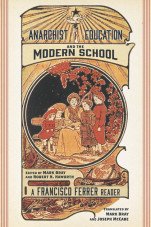
On October 13, 1909, Francisco Ferrer, the notorious Catalan anarchist educator and founder of the Modern School, was executed by firing squad. The Spanish government accused him of masterminding the Tragic Week rebellion, while the transnational movement that emerged in his defense argued that he was simply the founder of the groundbreaking Modern School of Barcelona. Was Ferrer a ferocious revolutionary, an ardently nonviolent pedagogue, or something else entirely? Anarchist Education and the Modern School is the first historical reader to gather together Ferrer’s writings on rationalist education, revolutionary violence, and the general strike (most translated into English for the first time) and put them into conversation with the letters, speeches, and articles of his comrades, collaborators, and critics to show that the truth about the founder of the Modern School was far more complex than most of his friends or enemies realized.
Autor*innen: Francisco Ferrer; Mark Bray and Robert H. Haworth (Editors)
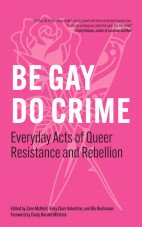
As communities are boldly rising to challenge capitalism, white supremacy, and authoritarianism, Be Gay, Do Crime: Everyday Acts of Queer Resistance and Rebellion is your ultimate guide to LGBTQ+ resiliente and rebellion. Packed with daily snapshots of radical queer history, this book celebrates the bold, the brave, and the beautifully defiant moments that have shaped the fight for justice.
Autor*innen: Blu Buchanan, Cindy Barukh Milstein, Riley Clare Valentine, Working Class History, Zane McNeill (Editors)

What does it mean to risk all for your beliefs? How do you fight an enemy in your midst? We Go Where They Go recounts the thrilling story of a massive forgotten youth movement that set the stage for today’s anti-fascist organizing in North America. When skinheads and punks in the late 1980s found their communities invaded by white supremacists and neo-nazis, they fought back. Influenced by anarchism, feminism, Black liberation, and Indigenous sovereignty, they created Anti-Racist Action. At ARA’s height in the 1990s, thousands of dedicated activists in hundreds of chapters joined the fights - political and sometimes physical - against nazis, the Ku Klux Klan, anti-abortion fundamentalists, and racist police. Before media pundits, cynical politicians, and your uncle discovered “antifa,” Anti-Racist Action was bringing it to the streets.
Autor*innen: Shannon Clay, Lady, Kristin Schwartz, and Michael Staudenmaier

Navigating the broad “river of anarchy,” from Taoism to Situationism, from Ranters to Punk rockers, from individualists to communists, from anarcho-syndicalists to anarcha-feminists, Demanding the Impossible is an authoritative and lively study of a widely misunderstood subject. It explores the key anarchist concepts of society and the state, freedom and equality, authority and power, and investigates the successes and failure of the anarchist movements throughout the world. While remaining sympathetic to anarchism, it presents a balanced and critical account. It covers not only the classic anarchist thinkers, such as Godwin, Proudhon, Bakunin, Kropotkin, Reclus and Emma Goldman, but also other libertarian figures, such as Nietzsche, Camus, Gandhi, Foucault and Chomsky. No other book on anarchism covers so much so incisively.
Autor*innen: Peter Marshall

In this collection of essays, written between the 1950s and 1980s and published here for the first time in English, Guérin not only provides a critique of the socialist and communist parties of his day, he analyzes some of the most fundamental and pressing questions with which all radicals must engage. He does this by revisiting and attempting to draw lessons from the history of the revolutionary movement from the French Revolution, through the conflicts between anarchists and Marxists in the International Workingmen’s Association and the Russian and Spanish revolutions, to the social revolution of 1968. These are not just abstract theoretical reflections, but are informed by the experiences of a lifetime of revolutionary commitments and by his constant willingness to challenge orthodoxies of all kinds: “Far from allowing ourselves to sink into doubt, inaction, and despair, the time has come for the left to begin again from zero, to rethink its problems from their very foundations. The failure of both reformism and Stalinism imposes on us the urgent duty to find a way of reconciling (proletarian) democracy with socialism, freedom with Revolution.”
Autor*innen: Daniel Guérin
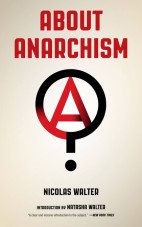
Today the word “anarchism” inspires both fear and fascination. But few people understand what anarchists believe, what anarchists want, and what anarchists do. This incisive book puts forward the case for anarchism as a pragmatic philosophy. Originally written in 1969 and updated for the twenty-first century, About Anarchism is an uncluttered, precise, and urgently necessary expression of practical anarchism. Crafted in deliberately simple prose and without constant reference to other writers or past events, it can be understood without difficulty and without any prior knowledge of political ideology.
Autor*innen: Nicolas Walter
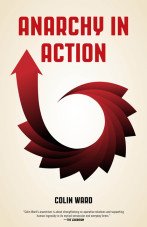
The argument of this book is that an anarchist society, a society which organizes itself without authority, is always in existence, like a seed beneath the snow, buried under the weight of the state and its bureaucracy, capitalism and its waste, privilege and its injustices, nationalism and its suicidal loyalties, religious differences and their superstitious separatism. Anarchist ideas are so much at variance with ordinary political assumptions and the solutions anarchists offer so remote, that all too often people find it hard to take anarchism seriously. This classic text is an attempt to bridge the gap between the present reality and anarchist aspirations, “between what is and what, according to the anarchists, might be.”
Autor*innen: Colin Ward
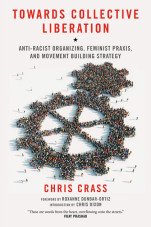
Towards Collective Liberation: Anti-Racist Organizing, Feminist Praxis, and Movement Building Strategy is for activists engaging with dynamic questions of how to create and support effective movements for visionary systemic change. Chris Crass’s collection of essays and interviews presents us with powerful lessons for transformative organizing through offering a firsthand look at the challenges and the opportunities of anti-racist work in white communities, feminist work with men, and bringing women of color feminism into the heart of social movements. Drawing on two decades of personal activist experience and case studies of anti-racist social justice organizations, Crass insightfully explores ways of transforming divisions of race, class, and gender into catalysts for powerful vision, strategy, and movement building in the United States today.
Autor*innen: Chris Crass
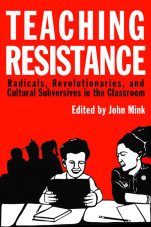
Teaching Resistance is a collection of the voices of activist educators from around the world who engage inside and outside the classroom from pre-kindergarten to university and emphasize teaching radical practice from the field. Written in accessible language, this book is for anyone who wants to explore new ways to subvert educational systems and institutions, collectively transform educational spaces, and empower students and teachers alike to fight for genuine change. Topics include community self-defense, Black Lives Matter and critical race theory, intersections between punk/DIY subculture and teaching, ESL, anarchist education, Palestinian resistance, trauma, working-class education, prison teaching, the resurgence of (and resistance to) the Far Right, special education, antifascist pedagogies, and more.
Autor*innen: John Mink (Editor)







 Meine Buchhandlung befindet sich in der Oelweingasse 36/5, 1150 Wien - einen Einblick bietet die Bildergalerie. Hier kannst Du in Ruhe schmökern, ich freue mich auf Deinen Besuch!
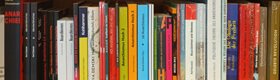 Die Buchhandlung ist jeden Dienstag und Mittwoch von 18:00 - 20:00 Uhr sowie jeden 1. und 3. Samstag im Monat von 12:00 - 16:30 Uhr geöffnet. Alle Artikel aus dem Shop sind vor Ort erhältlich.